
Table of Contents
- Child Friendly Dental Office Features That Actually Reduce Anxiety
- Welcoming Reception Areas, Playrooms, and Kid-Sized Comforts
- What Makes a Pediatric Dentist for an Anxious Child Different
- Dental Office Sensory-Friendly Features for Neurodivergent Kids
- How to Prepare a Child for the Dentist Before the Visit
- Using a Dental Visit Social Story for Autism at Home
- Safety, Accessibility, and Parent Accommodations to Check
- Conclusion
- Frequently Asked Questions
Last Updated: October 20, 2026
Child Friendly Dental Office Features That Actually Reduce Anxiety
A child friendly dental office is a practice designed around how children experience a dental visit: bright and playful spaces, child-sized equipment, staff trained to reassure young patients, and sensory accommodations that lower stress.
The core issue is control. A child who feels trapped, startled by sound, or unsure what happens next will resist treatment regardless of how many murals are on the wall.
Below, we break down the design and staff practices that matter most, plus a checklist for evaluating any office.
Welcoming Reception Areas, Playrooms, and Kid-Sized Comforts
The best reception areas separate two jobs: a calm space for parents to handle paperwork and an activity area where children can settle in.
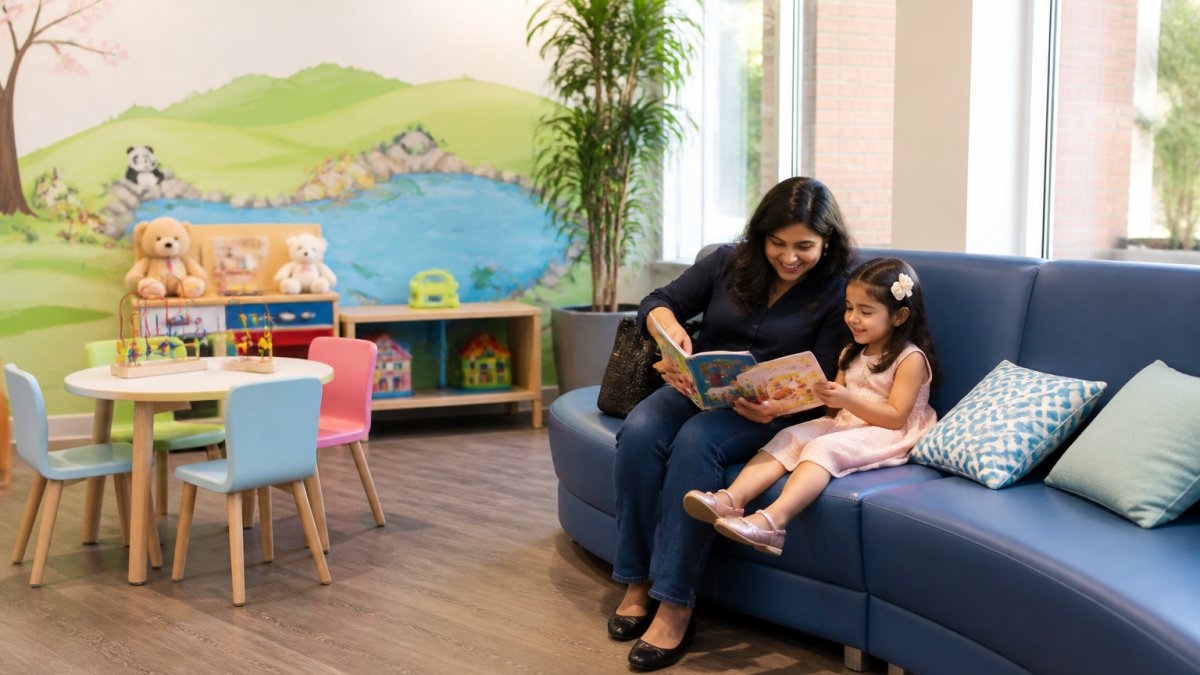
Most guides stop at “colorful and fun.” The more useful question is whether the waiting area is designed to lower arousal, not just raise it. A room can be bright and still be overstimulating. Use these details to tell the difference:
- Child-sized seating so young patients are not dangling from adult chairs, with at least one seat near a parent.
- A defined play area away from the front door and checkout traffic, so a child is not bumped or crowded during check-in.
- Bright colors and child-friendly décor that read as playful, not clinical, ideally with a coherent theme rather than a jumble of characters.
- Books and quiet activities for children who find screens overstimulating, alongside any tablets or TVs.
- Clear sightlines so a parent can watch a child from the intake desk.
- A quieter corner with softer lighting or a small nook, which matters for children who need to decompress before an appointment.
- A visible, child-height hand-sanitizer station and a toy-cleaning routine, so the play area does not become a germ-sharing station.
A common mistake is judging an office by décor alone. A colorful room with a rushed, noisy front desk still produces anxious children.
Ask whether the office schedules young children at quieter times of day. A calm, low-traffic slot often matters more than the toys in the corner. On a tour, watch how the front desk greets a nervous child; a staff member who crouches to the child’s eye level and explains what happens next is showing you the office’s real design philosophy.
What Makes a Pediatric Dentist for an Anxious Child Different
A pediatric dentist for an anxious child is trained in behavior guidance, not just clinical technique.
The reassuring approach matters more than any single piece of equipment.
For a first dental visit, a pediatric practice should also be set up for preventive care and early intervention.
At Pediatric Dental Excellence, care is led by a Board Certified Pediatric Dentist, Dr.
Dental Office Sensory-Friendly Features for Neurodivergent Kids
Sensory-friendly dental offices adjust lighting, sound, and touch to reduce overload for children with autism or sensory processing differences. These accommodations are the features most guides skip, and they are often the difference between a completed exam and a meltdown in the parking lot.
Lighting, sound, and touch accommodations
Ask specifically about each of these before booking:
- Lighting: dimmable overhead lights, and the option to wear sunglasses or a visor during the exam.
- Sound: quiet rooms, headphones or ear defenders, and staff who warn a child before equipment runs.
- Touch: a weighted lap pad or blanket, a calm-down space, and permission to decline a hug or high-five.
- Pacing: breaks on request, and a stop signal the child can use without speaking.
- Familiarization: a pre-visit tour or a photo walkthrough of the office.
A parent knows their child’s triggers better than any clinician. A good office asks about them at intake and writes them into the chart.
An office that dismisses sensory needs as “kids being difficult” will not adapt mid-appointment. Ask about accommodations on the phone, before the first visit, and treat a vague answer as a red flag.
How to Prepare a Child for the Dentist Before the Visit
Preparation at home lowers anxiety more than anything that happens in the chair. Parents can preview the visit, practice the sequence of events, and set clear expectations in the days beforehand.
Use this checklist in the week before an appointment:
- Read a picture book about a dental visit together.
- Walk through the steps out loud: check-in, sitting in the chair, counting teeth, cleaning, a small reward.
- Practice opening wide and holding still for a count of ten.
- Let the child pick a comfort item to bring.
- Avoid promising “it won’t hurt” and instead explain what the child will feel and hear.
Frame the visit as routine, not a big event. A calm, matter-of-fact tone from a parent carries more weight than reassurance delivered in the waiting room.
Schedule An Appointment Today →
Using a Dental Visit Social Story for Autism at Home
A dental visit social story for autism is a short, first-person narrative that describes what will happen at the appointment in plain, predictable language. Social stories work because they replace uncertainty with a script a child can rehearse.
A simple version follows this structure:
- “I am going to the dentist to keep my teeth healthy.”
- “I will sit in a big chair that goes up and down.”
- “The dentist will count my teeth with a small mirror.”
- “I can raise my hand if I need a break.”
- “When I am done, I get to pick a sticker.”
Keep the language literal and the sequence accurate. Ask the office what the visit will actually include so the story matches reality.
The most effective preparation is specific and honest. Children cope better with a known, accurate sequence than with vague reassurance.
Safety, Accessibility, and Parent Accommodations to Check
Safety and accessibility are the features parents rarely think to ask about, and the ones that most often fall short. This section turns those vague reassurances into specific things you can verify on a tour or with a few direct questions.
Infection prevention you can actually see
Pediatric offices follow standard precautions, the same baseline used across health care: hand hygiene before and after every patient contact, sterile instruments, and single-use barriers on high-touch surfaces. You do not need to audit the sterilization room, but you can watch for the visible signals:
- Hand hygiene in plain sight. Staff clean hands before gloving and after removing gloves. Sinks or hand-sanitizer stations should be visible in treatment areas.
- Sealed instrument pouches. Sterilized instruments arrive in dated, sealed pouches opened in front of the patient. Ask what the office’s sterilization monitoring process is; a confident, specific answer is a good sign.
- Barriers on shared surfaces. Look for plastic wrap or covers on light handles, chair controls, and X-ray sensors that are changed between patients.
- Single-use items. Needles, suction tips, and prophy angles should come out of packaging in the room.
- Separated play and clinical areas. Toys and books should not sit in treatment rooms, and a play area should be positioned away from checkout traffic and the door, as noted earlier.
Ask the front desk one direct question: “What does your team do between patients to clean the room?” A specific, practiced answer tells you more than a framed certificate on the wall.
Accessibility beyond wheelchair access
Mobility access is the easy part to check: a wheelchair-accessible entrance, a transport chair, and enough room around the chair for crutches or assistive equipment. The harder and more useful questions are about sensory, communication, language, and scheduling access:
- Sensory access. Quiet spaces, dimmable lighting, and ear defenders, covered in the sensory section above, are accessibility features, not extras.
- Communication access. Written instructions, plain-language treatment explanations, and staff who speak directly to the child rather than over their head.
- Language access. Ask whether the office provides interpretation or has bilingual staff, and whether forms and after-visit instructions are available in the family’s preferred language.
- Scheduling access. Early-morning and after-school slots, reminder systems, and a clear policy for late arrivals or cancellations.
- Physical access. Parking, doorway width, and restroom accessibility, which matter for families managing strollers, wheelchairs, or multiple children.
Parent and caregiver accommodations
Caregiver presence is one of the strongest anxiety reducers for young children, so ask about it before booking:
- Can a parent stay in the room during treatment? Policies vary, and a practice that welcomes a calm caregiver in the room is usually signaling confidence in its behavior guidance.
- Is there family seating? Room for siblings and a second caregiver makes a difference on appointment day.
- How are same-day emergencies handled? Ask whether the office reserves emergency slots and what the after-hours process is.
- What does transparent communication look like? Request a written treatment plan with itemized costs before any restorative care begins. A clear plan is the simplest test of whether an office communicates honestly.
- What if the family has no dental insurance? Ask about in-office membership or savings plans that spread cost predictably. Pediatric Dental Excellence offers a Dental Club membership plan for families without insurance, which is worth asking about directly rather than guessing at out-of-pocket costs.
A vague answer to “can I stay with my child?” or “how do you handle a child who needs a break?” is a red flag. Offices that have thought about anxious children answer these questions quickly and specifically.
A quick pre-booking checklist
Use these questions on the phone or during a tour, before you commit to a first visit:
- What ages does the practice treat, and is the dentist board certified in pediatric dentistry?
- How does the office clean and sterilize instruments between patients?
- Can a parent stay in the treatment room?
- What sensory accommodations are available, and how do I note my child’s triggers in advance?
- Is there a quiet space or a stop signal my child can use?
- What is the policy for same-day emergencies?
A practice that answers these without hesitation is showing you its systems, not just its décor.
Conclusion
Choosing an office comes down to whether it treats anxiety as a design problem or a personality flaw. The features that matter most, predictable routines, sensory accommodations, trained staff, and honest communication, are the ones a parent can verify with a few direct questions.
Pediatric Dental Excellence is built for exactly that conversation: a Board Certified Pediatric Dentist leading care for ages 0 to 17, a Dental Club membership plan for families without insurance, and a team that explains each step before it happens.
Frequently Asked Questions
What features make a dental office child-friendly?
A child friendly dental office combines a welcoming reception area with playrooms, toys, books, and bright colors that put kids at ease. Beyond décor, look for child-sized instruments, equipment that is hidden or decorated to look less intimidating, staff trained to explain each step in kid-friendly language, and small rewards like stickers at the end. Sensory-friendly touches such as adjustable lighting and quiet spaces also matter, especially for children with autism or sensory processing differences.
How can a pediatric dentist help a child with dental anxiety?
A pediatric dentist for an anxious child uses a tell-show-do approach: explaining each tool, showing how it works, then using it only after the child agrees. Staff also use distraction techniques like visual seek-and-find games, and parents can request breaks at any point.
How can I prepare my child for their first dental visit?
Start a week ahead by reading picture books about dentists, playing pretend dentist at home, and talking through what will happen in simple, positive terms. Avoid words like ‘shot’ or ‘drill’ and let the dentist introduce tools instead. Schedule the appointment for a time your child is usually rested and fed. Tell the office in advance about any fears, sensory triggers, or special needs so the team can adjust the visit. On the day, stay calm yourself, since children pick up on parent nerves.
How can a dental office accommodate a child with autism or sensory sensitivities?
Ask whether the office offers a sensory-friendly visit, which often means a quieter time slot, dimmed lights, reduced noise, and a slow-paced tour before any treatment. A dental visit social story for autism, showing photos of the office and each step, helps children know what to expect. Parents can request a weighted lap pad, sunglasses for overhead lights, or noise-reducing headphones. Some offices also provide a calm-down space and let families complete paperwork ahead of time to shorten the visit.


