
Table of Contents
- Why the First Dental Visit Matters More Than You Think
- The Magic Number: When Should Baby First Dental Visit?
- Pediatric Dental Exam Expectations: What Happens at the First Visit
- How to Prepare Toddler for Dentist: A Step-by-Step Guide
- Common Pediatric Dental Procedures for Toddlers
- Infant Oral Health Best Practices: Daily Care Between Visits
- After the Visit: Follow-Up Care and Next Steps
- Frequently Asked Questions
Last Updated: September 20, 2026
Why the First Dental Visit Matters More Than You Think
The most important dental appointment of a child’s life happens before they can say a word. According to the [American Academy of Pediatric Dentistry](https://www.aapd.org/resources/parent/), establishing a dental home by the first birthday sets the foundation for a lifetime of oral health, yet many parents delay the visit until a visible problem appears.
The Magic Number: When Should Baby First Dental Visit?
The answer is simple: by the first birthday, or within six months of the first tooth erupting, whichever comes first. This is the standard recommendation from the American Dental Association and pediatric dental organizations nationwide.
The First Birthday Milestone and the 1-Year Rule
The first birthday milestone is not arbitrary. It aligns with shifting feeding habits, accelerated teething, and rising bottle rot risk. A screening lets a pediatric dentist evaluate eruption patterns, check gum health, and identify tongue-tie or lip-tie that can affect feeding and speech.
What If My Baby Is Older Than One?
Older is not too late. If a child is two or three and has never seen a dentist, schedule now. The first visit still focuses on prevention, but the dentist may address existing decay or developmental concerns. Many families come to Pediatric Dental Excellence after delaying, and the team focuses on moving forward, not blame.
Pediatric Dental Exam Expectations: What Happens at the First Visit
A first pediatric dental exam is brief, gentle, and parent-centered. The dentist assesses the mouth, counts erupted teeth, checks for early decay and gum issues, and reviews feeding and hygiene routines. For infants, much of the appointment is education: cleaning gums, teething expectations, and preventing early childhood caries.
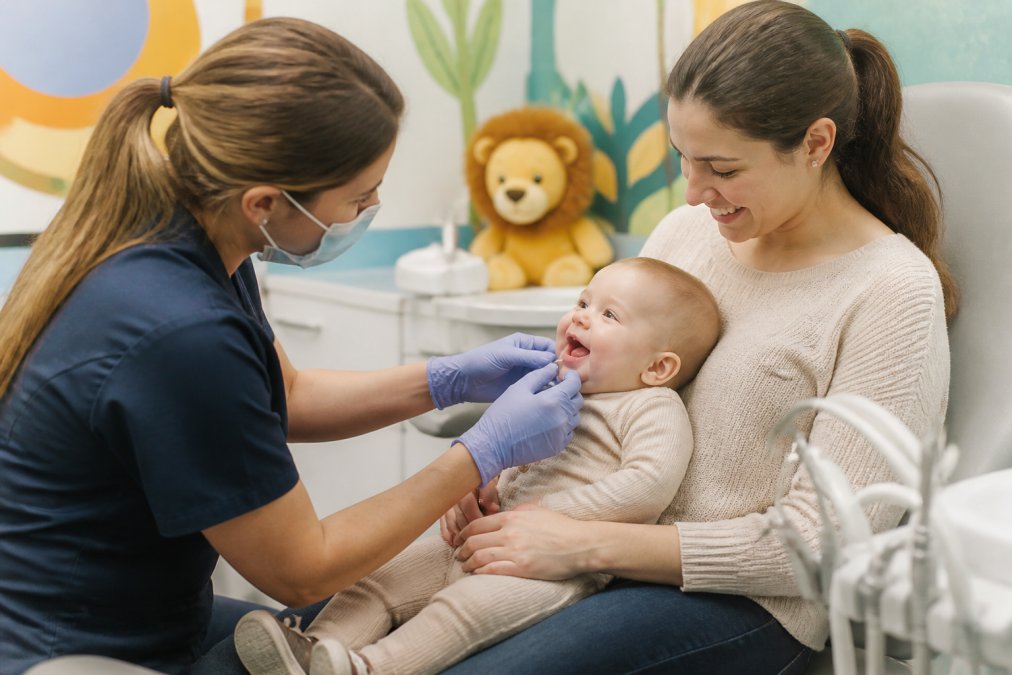
The Knee-to-Knee Exam Explained
The knee-to-knee exam is the standard positioning technique for infants and toddlers. The parent sits facing the dentist, knee to knee, and the child lies back across both laps. This gives the dentist a clear view while keeping the child secure in the parent’s presence, reducing anxiety and allowing a thorough exam without restraint.
A Minute-by-Minute Walkthrough of the First Visit
Most first visits follow a predictable rhythm. Knowing the sequence removes the biggest source of parental anxiety, the unknown.
- Check-in and paperwork (5-10 minutes). You will complete a health history form covering feeding method, medications, medical conditions, and any family history of dental problems.
- Meet the dentist and tour the room (2-3 minutes).
- Knee-to-knee exam (5-10 minutes). The dentist counts teeth, checks the gum line, looks for white-spot lesions, and evaluates the frenulum (tongue-tie and lip-tie).
- Gentle cleaning (2-5 minutes). A soft brush or gauze is used; no scraping or polishing on most infants.
- Fluoride varnish, if indicated (1-2 minutes). A small amount is painted on the teeth. It is not a rinse and does not require the child to spit.
- Parent education and Q&A (5-10 minutes). This is often the longest part of the visit and the most valuable.
What If My Baby Cries During the Exam?
Crying is normal and expected, a crying baby opens their mouth wider, which helps the dentist see. The exam is not painful, and the dentist will pause, reposition, or hand the baby back if distress escalates. A crying baby is not a failed visit; what matters is that the exam gets completed and the child leaves without a negative association.
How Long Does It Take and What Will It Cost?
A first visit typically lasts 15 to 30 minutes of chair time. Cost varies by practice, region, and insurance.
- What is the cash price for a first exam, cleaning, and fluoride varnish?
- Is there a membership or in-house plan, and what does it include?
- Are there separate charges for X-rays or a consultation?
| Visit Component | Typical Duration | What to Expect |
|---|---|---|
| Intake and history review | 5-10 minutes | Feeding habits, hygiene routine, medical background |
| Clinical assessment | 5-10 minutes | Tooth count, gum check, decay screening |
| Parent education | 5-10 minutes | Cleaning technique, teething guidance, diet advice |
Ask for the billing codes before the appointment. Preventive pediatric visits are usually coded as a periodic oral evaluation, a prophylaxis, and a topical fluoride application. Knowing the codes lets you verify coverage with your insurer in a single phone call.
How to Prepare Toddler for Dentist: A Step-by-Step Guide
Preparation starts at home, not in the waiting room. A child who knows what to expect handles the appointment with far less anxiety. This approach works for most toddlers and can be adapted for sensory processing differences.
- Read a picture book about dental visits several days before the appointment.
- Practice “open wide” at home during brushing so the action feels familiar.
- Use neutral language. Avoid words like “pain,” “shot,” or “drill.”
- Schedule for a calm time of day, not during naptime or after a long day.
- Bring a comfort item such as a stuffed animal or blanket.
- Stay relaxed yourself. Children read parental anxiety quickly.
- Plan a small reward after the visit, not as a bribe but as a routine.
Sensory-Friendly Preparation for Children with Autism
For children with autism or sensory processing disorders, standard preparation may not be enough. Do not assume the child will “get used to it” on arrival. Sensory-friendly preparation means calling ahead to discuss triggers, requesting a quiet appointment time, and asking about a pre-visit tour.
Ask if the practice offers a “meet and greet” visit with no exam. A short, low-pressure introduction to the office, the chair, and the team often prevents the meltdown that happens when a child’s first experience is a full appointment.
Common Pediatric Dental Procedures for Toddlers
Most first visits involve no procedures beyond the exam and a gentle cleaning. When treatment is needed, common pediatric dental procedures for toddlers include fluoride treatment, sealants on primary molars, and small fillings for early cavities. Extraction is rare, reserved for severely decayed or infected teeth.
Teething vs. Decay: How to Tell the Difference
Teething and decay can look similar but behave differently. Teething causes generalized gum discomfort, drooling, and fussiness that comes and goes. Decay shows as white or brown spots, sensitivity to sweet or cold foods, and persistent discomfort in one area. If a spot does not wipe off, it is not teething.
Do not assume every white spot is teething. Early childhood caries often begins as faint white lesions that are reversible with fluoride and improved hygiene. Once they turn brown, the damage is permanent and requires a filling.
Infant Oral Health Best Practices: Daily Care Between Visits
Daily care matters more than any single appointment. Infant oral health best practices begin before the first tooth appears and continue through toddlerhood, keeping plaque from accumulating and building habits that carry into childhood.
Cleaning Gums and Erupted Teeth
Wipe gums with a clean, damp gauze pad or soft cloth twice a day, especially after feeding. Once teeth erupt, switch to a small, soft-bristled toothbrush with a rice-grain smear of fluoride toothpaste for children under three. Brush gently in small circles along the gum line and clean the tongue when possible.
Preventing Early Childhood Caries and Bottle Rot
Bottle rot develops when sugary liquids pool around teeth for long periods. Never put a baby to bed with a bottle of milk, formula, juice, or sweetened drink. Avoid grazing on sugary snacks. Offer water between meals, limit juice to meals in small amounts, and wipe gums and teeth after nighttime nursing.
Schedule An Appointment Today →
After the Visit: Follow-Up Care and Next Steps
The first visit is the beginning of an ongoing relationship, not a one-time event. What you do in the 48 hours after, and the months between visits, determines whether it pays off.
The First 24 to 48 Hours After the Exam
A few things right after a first visit surprise parents:
- Fluoride varnish residue. If fluoride varnish was applied, you may see a dull, yellowish film on the teeth. It is normal and wears off within a day. Avoid brushing, hard foods, and hot drinks for the rest of the day so the varnish can set.
- Mild gum tenderness. A gentle cleaning can leave gums slightly pink for a few hours. This is not a sign of injury.
- Fussiness or a skipped nap. The appointment itself is stimulating. A fussy afternoon is common and not a reason to worry.
- A child who suddenly refuses the toothbrush. This is a temporary protest, not a permanent one. Keep the routine gentle and consistent.
Your Written Take-Home Plan
Before you leave, get clear answers to four questions:
- What is the recommended date for the next exam?
- What specific home-care routine should we follow, and how often?
- Are there any teeth or spots the dentist wants to monitor?
- What symptoms should prompt a call before the next scheduled visit?
Write these down. Memory fades in a busy waiting room, and the answers make the next six months effective.
The Six-Month Recall, and Why It Matters
The standard recall interval is every six months, though some children need three- or four-month visits for active decay, enamel defects, or high-caries-risk feeding. A common mistake is skipping the second visit because the first went smoothly. Consistent preventive care keeps small issues from becoming expensive ones.
- White or brown spots on the teeth that do not wipe off
- Bleeding gums during brushing
- Persistent bad breath that does not improve with cleaning
- A tooth that looks chipped, gray, or darker than its neighbors
- Swelling of the gum or face
- A fever with no other obvious cause in a teething-age child
Teething vs. Decay: A Symptom Checklist for the Between-Visit Window
Parents often confuse teething with a developing cavity. The difference matters: one resolves on its own, the other gets worse.
| Symptom | More Likely Teething | More Likely Decay or Infection |
|---|---|---|
| Drooling | Yes, often heavy | No change |
| Gum discomfort | Generalized, comes and goes | Localized to one tooth or area |
| Visible spot on tooth | None | White, brown, or black spot that does not wipe off |
| Reaction to sweet or cold | Mild, brief | Sharp, repeatable, tied to a specific tooth |
| Fever | Low-grade, if any | Higher fever with swelling suggests infection |
| Sleep disruption | Intermittent, tied to eruption | Persistent, worsening over days |
Dental Emergencies Between Visits
If a child has a dental emergency between visits, a knocked-out tooth, chipped front tooth, gum or facial swelling, or uncontrolled bleeding, contact the practice immediately. A knocked-out primary tooth is usually not reimplanted, but same-day evaluation rules out damage to the underlying permanent tooth.
The first dental visit is a milestone, not a treatment. Its purpose is to establish a dental home, catch problems early, and give parents the tools to prevent decay at home. What happens after the visit, the follow-up, the six-month recall, and the daily routine, is where that purpose actually gets fulfilled.
Frequently Asked Questions
What is the recommended age for a child’s first dental visit?
The American Academy of Pediatric Dentistry (AAPD) recommends that a baby first dental visit happen by their first birthday or within six months of the first tooth erupting, whichever comes first. This early timing allows the dentist to check oral development, discuss feeding and hygiene habits, and catch issues like early childhood caries before they progress. If your baby is older than one and has not seen a dentist yet, schedule an appointment as soon as possible.
How do I prepare my toddler for the dentist?
To prepare toddler for dentist, start a few days ahead with simple, positive language. Read a children’s book about dentist visits, play pretend with a toothbrush, and avoid words like ‘pain’ or ‘shot.’ Schedule the appointment for a time when your child is well-rested, like after a nap. Bring a comfort item. Tell the dental team about any anxiety or sensory needs so they can adjust their approach. On the day, stay calm yourself; children pick up on parental stress.
What happens during a baby’s first dental exam?
A pediatric dental exam expectations session is typically short, about 15 to 30 minutes. The dentist will ask about your baby’s health history, feeding habits, and any concerns. They will examine erupted teeth, gums, tongue, and lips, often using a knee-to-knee position with you holding your baby. They may clean the teeth, apply fluoride if needed, and demonstrate how to brush at home. You will leave with a personalized plan for infant oral care and a schedule for follow-up visits.
Can a 3-month-old go to the dentist?
A 3-month-old typically does not need a dental visit unless there is a specific concern such as a tongue-tie, lip-tie, or visible oral issue. The standard recommendation is by the first birthday or within six months of the first tooth. However, if you notice white spots, unusual gum swelling, or feeding difficulties, consult a pediatric dentist earlier. For routine care, wait until the first tooth appears or your baby turns one.
What is the 3-3-3 dental rule?
The 3-3-3 dental rule is a memory aid for parents: brush for 3 minutes, 3 times a day, and see the dentist every 3 months? Actually, the more common interpretation is: brush 3 times a day for 3 minutes, and visit the dentist every 3 months is not standard. The widely accepted rule is ‘2-2-2’: brush 2 times a day for 2 minutes, and see the dentist every 2 years? No, that is incorrect. The 2-2-2 rule is: brush 2 times a day for 2 minutes, and visit the dentist every 6 months. The 3-3-3 rule is not a recognized dental guideline; always follow your dentist’s advice for your child’s individual needs.
How do I clean my baby’s gums before teeth emerge?
Before teeth emerge, wipe your baby’s gums with a clean, damp washcloth or gauze pad after feedings. This removes dental plaque and gets your baby used to having their mouth cleaned. Once the first tooth erupts, switch to a soft-bristled infant toothbrush with a smear of fluoride toothpaste (rice-grain size). Clean gums and teeth twice daily, especially before bedtime. These infant oral health best practices help prevent early childhood caries and establish a lifelong routine.
Is teething pain or tooth decay causing my baby’s discomfort?
Teething typically causes mild gum swelling, drooling, and a desire to chew, but it does not cause severe pain, high fever, or diarrhea. Tooth decay, on the other hand, may present as white spots on teeth, brown or black discoloration, or sensitivity when eating. If your baby has a fever above 101°F or seems very uncomfortable, consult a pediatrician. A pediatric dentist can differentiate teething from decay during a dental exam and recommend appropriate care.
What should I expect for post-visit care and follow-up?
After the first dental visit, you will receive instructions for at-home oral hygiene, including brushing technique, fluoride use, and feeding recommendations. The dentist will schedule the next check-up, usually in six months, but more often if there are concerns. If your child had a fluoride treatment, wait 30 minutes before eating or drinking. If a procedure was done, follow any specific care instructions. Keep a record of your child’s dental milestones and share them with your pediatrician. Consistent follow-up prevents small issues from becoming serious.